The Nikolaiviertel is a small pedestrian quarter beside the River Spree in central Berlin. Its lanes, St Nicholas Church and historic houses evoke an older city, but much of what visitors see was reconstructed in the 1980s after wartime destruction. Understanding that mixture makes the visit more interesting. This guide covers the main sights, the quarter’s layered history, museums, food and practical walking routes.
At a glance: Nikolaiviertel
- Location: Berlin-Mitte, between Alexanderplatz and Museum Island, beside the Spree.
- Main sights: Nikolaikirche, Ephraim-Palais, Knoblauchhaus and pedestrian lanes.
- Walking through the quarter: free; museum admission varies.
- Allow: 30 to 60 minutes for the streets, two hours or more with a museum and meal.
- Historical note: much of the present quarter is a GDR-era reconstruction.
Stay near the Nikolaiviertel
Mitte is convenient for the quarter, Museum Island and central transport. Compare the exact hotel location and nearby stations before booking.
What makes the Nikolaiviertel distinctive?
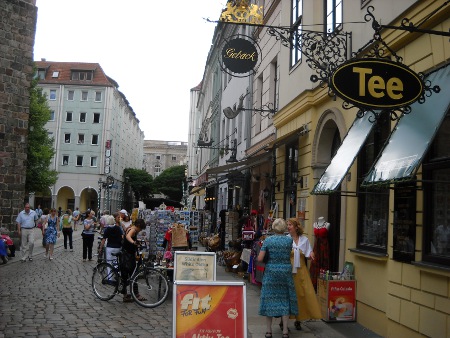
Berlin does not have a large, intact medieval old town in its centre. The Nikolaiviertel gives a sense of the city’s earliest urban core on a compact scale. Low buildings, small squares and pedestrian lanes contrast with the broad streets around Alexanderplatz. It is easy to add to a day around Unter den Linden and Museum Island. The quarter is pleasant for a short walk, but its appearance needs explanation: it is neither entirely original nor simply a modern imitation.
Wartime bombing severely damaged the area. During the 1980s, East German authorities reconstructed the quarter as Berlin approached its 750th anniversary. Some buildings were rebuilt with historical references, while others used contemporary construction behind traditional-looking façades. This is part of the quarter’s story and a useful reminder that urban history continues through demolition, reconstruction and the choices of later generations.
Nikolaikirche: the historic centre
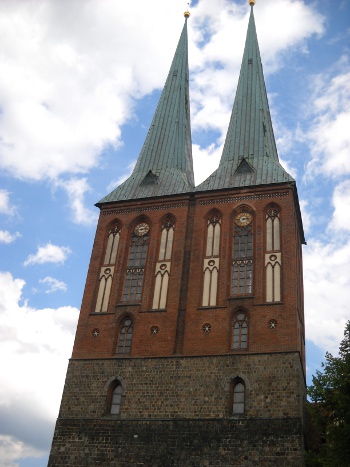
St Nicholas Church, or Nikolaikirche, is central to the district’s identity. Its origins reach back to medieval Berlin, although the building has changed over centuries and suffered severe damage in the Second World War. The church was reconstructed during the creation of the present Nikolaiviertel and now serves as a museum rather than an ordinary parish church. Exhibitions connect its architecture with the city’s long history. Check the current museum programme and opening hours if you want to enter.
Even an exterior visit is worthwhile. The twin towers help orient you in the lanes, and the square around the church offers a place to pause. Look at the proportions of the building and compare them with the smaller houses nearby. Inside, historical interpretation is more useful than simply treating the church as a picturesque interior. The building shows how several eras have left traces in one urban site.
Visitors interested in music should check the museum’s current event calendar. Concerts and other programmes can be separate from a standard daytime visit. Do not assume the church is open at all hours because the surrounding quarter is accessible. If entry matters, plan the museum first and then use the lanes and riverside as flexible additions.
Ephraim-Palais and Knoblauchhaus
The Ephraim-Palais is known for its curved Rococo-style façade and exhibitions on Berlin’s culture and history. Its reconstruction was part of the 1980s redevelopment, based on earlier architectural plans. The building itself raises questions about how a city decides what to restore. Check the exhibition currently on display; temporary programmes can make two visits very different. It is one of the quarter’s most conspicuous architectural stops.
The Knoblauchhaus offers another perspective: a historic domestic setting associated with a prosperous Berlin family. Its rooms and furnishings illustrate bourgeois life, particularly in the Biedermeier period. Compared with a large national museum, it is more intimate and easier to fit into a short itinerary. Its opening hours and ticket conditions should still be checked before travelling.
These institutions, together with Nikolaikirche, are sometimes offered through a combined museum ticket. Compare the current ticket with individual admissions if you intend to visit all three. For a casual half-hour walk, there is no need to buy any museum ticket. For a history-focused morning, the interiors give substance to the reconstructed streets outside.
A walking route through the quarter
Begin near Rotes Rathaus or the nearby U-Bahn station, then enter the pedestrian lanes towards Nikolaikirche. Walk around the church and continue to the small squares and the Ephraim-Palais. From there, look for the Knoblauchhaus and head to the Spree bank. This route is short on a map, but stop to compare façades, signs and older details with reconstructed ones. The bronze St George and the Dragon sculpture is another easy landmark to notice along the way.
Cross to a nearby bridge for a wider view of the river and the district. The Spree connects the Nikolaiviertel visually to Museum Island and offers a useful orientation point. If you have more time, continue towards the Humboldt Forum or Berlin Cathedral, then north to the Bode Museum. If you prefer a commercial and lively neighbourhood afterwards, the Hackesche Höfe lie farther north.
Another direction leads west through the historic centre towards Brandenburg Gate. That is a longer walk with many stops, so do not rush it merely to tick off another landmark. The Nikolaiviertel rewards attention to small streets, whereas the grand boulevard shows a different Berlin.
Food and cafés in the Nikolaiviertel
The pedestrian quarter has restaurants, cafés and pubs, some serving Berlin or broader German dishes. Its central setting makes it convenient for a meal between sights. Compare menus and prices before sitting down, as venues range from simple breaks to more tourist-oriented dining. A riverside table may be pleasant in good weather but can fill quickly; a nearby side street may be quieter. Opening hours vary widely, particularly outside peak season.
If food is the main reason for your visit, check the specific restaurant rather than assuming every traditional-looking façade houses a traditional kitchen. A short coffee stop is easy to combine with the walking route. For a more extensive choice of independent venues, nearby neighbourhoods around Hackescher Markt and other parts of Mitte offer alternatives. The quarter is small, so you can examine a few menus on foot.
Boat trips from the historic centre
Some Berlin sightseeing cruises depart from piers within walking distance of the Nikolaiviertel. A boat can extend your visit along the Spree towards Museum Island and the government quarter. Check the exact pier on the ticket: a product described as a central Berlin cruise may leave at Friedrichstraße instead. The boat-tour guide compares short central trips with longer routes and lake outings.
A cruise is optional. The short riverside walk and bridges already give good views without a ticket. Choose the boat if you want commentary and a seated overview, especially on a first visit. If your main interest is the district’s history, spend the extra time inside Nikolaikirche or the other museums instead of hurrying away.
Berlin activities near the historic centre
Compare the actual departure pier and timetable before pairing a boat trip with your Nikolaiviertel walk.
Compare Berlin Spree sightseeing cruises at Tiqets Check the departure pier, duration, route and commentary language in the selected offer. · Browse Berlin tickets and activities at Tiqets
How to get there
Rotes Rathaus on the U5 is a convenient station near the quarter. Alexanderplatz is a major transport hub within walking distance; other central stops can also work. Use a current public transport planner from your starting address. Older descriptions that call the U5 extension a future construction project are out of date. Walking from Museum Island is straightforward, and there is no need to drive into the centre for such a compact pedestrian visit.
Most of the quarter’s public streets are accessible on foot at any time, but entrances, exhibitions and dining businesses have their own hours. Cobblestones and uneven surfaces can make some routes uncomfortable for wheelchair users or people with limited mobility. Check the access information for individual museums, and choose the simplest approach from a nearby station rather than relying on the apparent closeness of a point on a map.
Best time and realistic expectations
Early morning is good for a quieter look at the lanes, though museums and cafés may not yet be open. Midday allows an interior visit and lunch but brings more visitors. Evening lighting can make the small streets attractive, while historical interpretation is harder when the museums are closed. The best time depends on whether you want photographs, a meal or exhibitions. Bad weather makes a museum-focused visit more appealing.
Do not expect a large surviving medieval quarter. The appeal is the compact reconstruction, the old street pattern, the church and the chance to examine Berlin’s changing relationship with its past. If you know this before arriving, you can appreciate the place without mistaking 1980s façades for untouched centuries-old houses. The story of rebuilding is itself part of Berlin history.
Stay near the Nikolaiviertel
Mitte is convenient for the quarter, Museum Island and central transport. Compare the exact hotel location and nearby stations before booking.
How the reconstruction changes what you see
The 1980s rebuilding is not merely a footnote. It shaped the lanes, façades and visitor experience during the final years of East Germany. Some structures draw closely on historical forms; others reveal modern construction when you look beyond the street-facing surface. This makes the Nikolaiviertel an interesting place to ask what an “old town” means after widespread destruction. A reconstructed quarter can preserve street scale and memory while also reflecting the priorities of the period that rebuilt it.
Look at photographs or museum displays showing earlier Berlin if you want to compare old and new. Avoid assuming that a building’s historic-style exterior proves the same walls stood there for centuries. The Nikolaikirche, Knoblauchhaus and Ephraim-Palais each have distinct histories, so their current appearances should not be grouped into one simple category. The public realm itself, with pedestrian lanes and places to sit, is also a product of planning decisions made in the twentieth century.
Visiting with children or limited time
For a family, keep the route short and let children find the church towers, bridge views and St George sculpture. A museum can add context, but three interiors in succession may be too much. The lanes are mostly pedestrian, though deliveries and access vehicles may still appear. Stay attentive near the river and when crossing larger surrounding streets. A café break can divide the visit into manageable pieces.
If you have only 30 minutes, start at Nikolaikirche, walk one loop through the lanes and finish at the river. If you have two hours, enter one museum and pause over lunch. If you have half a day, add Museum Island or a central Spree cruise. These choices offer clearer value than repeatedly crossing the same tiny quarter just to stretch the visit to an arbitrary length.
What the quarter is not
The Nikolaiviertel is not a large shopping district, an untouched medieval settlement or a comprehensive explanation of Berlin’s history by itself. It is one small part of Mitte. Alexanderplatz shows a different chapter of twentieth-century planning, Museum Island expresses nineteenth-century cultural ambition, and Unter den Linden tells another story of the capital. Putting the quarter in this wider context helps visitors understand why it feels different from the streets surrounding it.
Likewise, a quick restaurant stop alone may leave you with only a picturesque impression. Reading a panel in Nikolaikirche or visiting the Knoblauchhaus can make the streets more meaningful. If you have no interest in interiors, even a careful look at the materials and street layout is worthwhile. The experience does not have to be long, but it benefits from knowing what you are seeing.
Frequently asked questions
The quarter is also a convenient meeting point for travellers with different interests. One person can visit a museum while another explores the riverside, then the group can meet for a meal without a long transfer across Berlin.
Is the Nikolaiviertel an original medieval old town?
It occupies Berlin’s historic core, but much of the present streetscape was reconstructed in the 1980s after wartime destruction.
Does walking through cost anything?
No. The public pedestrian lanes are free. Museum visits and food have separate prices.
How long do I need?
Allow at least half an hour for the streets and more if you enter a museum or stop for a meal.
Which station is useful?
Rotes Rathaus is close, while Alexanderplatz offers many rail connections within walking distance.