The Spree runs through the centre of Berlin and links several of the city’s best-known sights. A walk along its banks can take you from historic Museum Island to the government quarter, while a boat trip shows how the city relates to the water. This guide explains the most useful sections for visitors, the difference between a riverside walk and a cruise, and how to plan a route.
At a glance: River Spree in Berlin
- Best central stretch: Museum Island, Nikolaiviertel and the government quarter.
- For contemporary architecture: East Side Gallery and Oberbaum Bridge.
- For a quieter outing: Treptower Park or the waterways around Köpenick.
- Short sightseeing cruise: often around one hour, depending on route.
- Cost of walking along the river: free; boat fares vary by operator and date.
Spree cruises in Berlin
Compare departure piers, duration and languages before booking. The established central sightseeing cruise is an option for a short introduction.
Compare Berlin Spree sightseeing cruises at Tiqets Check the departure pier, duration, route and commentary language in the selected offer. · Browse Berlin tickets and activities at Tiqets
Where does the Spree flow through Berlin?
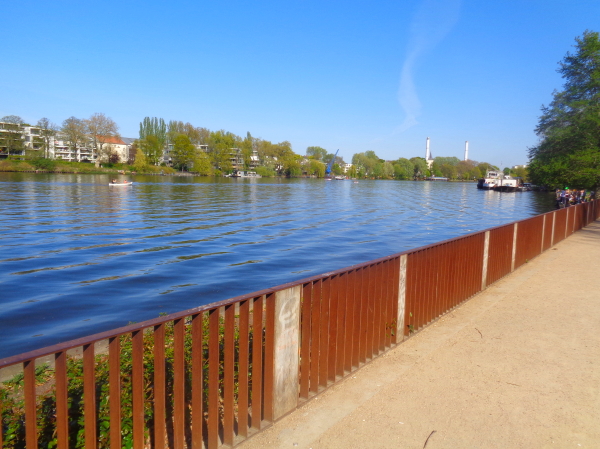
The river rises outside Berlin in Saxony, crosses Brandenburg and eventually meets the Havel in Spandau. Within Berlin it passes Köpenick and Treptow in the southeast, the area around the East Side Gallery, the historic centre, the government district and Charlottenburg. The route is not a straight line: the bends create very different views at each bridge. Berlin’s waterways also include the Havel, the Dahme and many canals and lakes. A visitor looking only at the city centre sees a relatively short, but particularly rich, stretch of the Spree.
At Köpenick the Dahme meets the Spree. Farther west the river passes the old city core and the parliamentary buildings before joining the Havel. This geography matters when booking a boat trip: a central sightseeing cruise and an excursion towards Müggelsee or the eastern lakes offer quite different experiences. Read our separate guide to the Dahme in southeast Berlin if you are planning a day on the water beyond the centre.
The most interesting central stretch
Museum Island and the historic centre
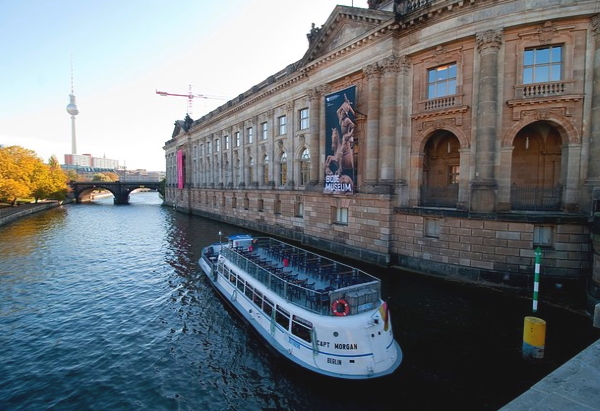
The buildings of the Bode Museum and the other museums are closely tied to the waterways around Museum Island. Bridges reveal changing views of the museum façades, Berlin Cathedral and the nearby Humboldt Forum. The riverbanks here are a good introduction to Berlin because many major sights lie within walking distance. From the island, you can continue to the Nikolaiviertel, a compact pedestrian quarter with cafés and small museums. It is also a useful area from which to join some central boat tours, although departure points depend on the operator.
Take a little time to cross more than one bridge. The river looks different from a footpath at water level, a bridge above the boats and a seat on the opposite bank. Museum Island can be busy around the main entrances, whereas a short walk often finds a quieter view. Visitors who want a museum stop should check current opening times before building a tightly timed route around a boat departure.
The government quarter and Spreebogen
West of the historic centre, the river curves around the government quarter. From the banks you can see the Reichstag area, federal buildings and the Chancellery. The modern parliamentary complex was designed with connections across the river, and a walk here is particularly useful for understanding how Berlin has changed since reunification. The river path allows you to observe the buildings without booking a tour, though entry to individual institutions follows separate procedures.
Several city cruises turn in or pass through this stretch. From a boat the contrast between older façades and modern glass-and-steel buildings is easy to see. Commentary can help identify places, but audio language, route and duration vary. Check the exact itinerary instead of assuming that every one-hour trip passes the same landmarks. The central station is not far from the river and is a convenient starting point for a walk through the government district.
East Side Gallery and Oberbaum Bridge
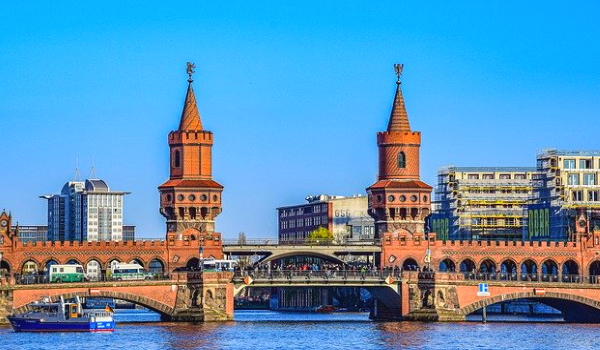
Farther east, the river separates Friedrichshain and Kreuzberg. The East Side Gallery occupies a surviving section of the Berlin Wall on the Friedrichshain bank. The Oberbaum Bridge, with its distinctive towers, connects the two sides. This section has a different character from Museum Island: the focus is on twentieth-century history, street life and views across the water. It works well as a separate outing, especially if you plan to spend time looking at the murals rather than simply taking a photograph.
The gallery is outdoors and generally accessible without a ticket. Treat the paintings as a memorial and artworks, and allow room for other visitors on the pavement. The riverbank itself can be lively, especially on warm evenings. If you prefer fewer people, start early. Continue across Oberbaum Bridge to see how the view changes from the Kreuzberg side.
Walk beside the Spree or take a boat?
Walking gives you control over your pace and makes it easy to leave the river for a museum, café or station. It is free and works throughout the year. A boat provides an uninterrupted view from the water and covers a longer stretch with less effort. The trade-off is a fixed route and timetable, plus a ticket cost. A short cruise is especially useful on a first visit if you want an overview of central Berlin. A walk is better for detailed visits to one neighbourhood.
These options combine well. For example, walk from Museum Island towards the government quarter, then take a cruise from a nearby pier if its route adds places you have not yet seen. Alternatively, start with a boat ride and return on foot to the area that interested you most. Do not assume the arrival pier is the same as the departure pier: check the ticket. In colder weather, look for a vessel with an enclosed cabin; in warm weather, an open deck is pleasant but may fill quickly.
Spree cruises in Berlin
Compare departure piers, duration and languages before booking. The established central sightseeing cruise is an option for a short introduction.
Compare Berlin Spree sightseeing cruises at Tiqets Check the departure pier, duration, route and commentary language in the selected offer. · Browse Berlin tickets and activities at Tiqets
Which boat tour should you choose?
A short city cruise
A roughly one-hour trip usually concentrates on the historic centre and government buildings. It is convenient when your sightseeing schedule is full or the weather makes a long outdoor walk less appealing. Exact landmarks depend on where the cruise begins and how the boat turns. Compare the map and boarding instructions carefully. Our guide to Berlin boat tours explains the main formats and how to select one.
A longer river and canal journey
Trips lasting several hours can add the Landwehr Canal, Charlottenburg or other parts of the water network. These suit visitors interested in the city’s layout and everyday neighbourhoods as much as its famous monuments. Longer does not automatically mean better: consider how much of the day you want to spend seated, what commentary is offered and whether refreshments are included or sold separately. Canal routes may vary with maintenance, water levels and operating conditions.
Eastern Berlin and the lakes
From Treptow and Köpenick, outings towards Müggelsee place more emphasis on trees, open water and residential waterfronts. These are not substitutes for a classic one-hour cruise past the Reichstag. They are alternatives for a slower day outside the busiest central area. Some boat services operate mainly in the warmer months. Check the return timetable carefully, particularly if you plan a walk or restaurant stop before heading back.
Planning a riverside walk
A practical central route begins near Hackescher Markt, crosses to Museum Island and continues past the cathedral to the Nikolaiviertel. From there, return along the other bank or take public transport west to the government quarter for a second walk. Trying to follow the water without interruption is not always possible: building sites, private property and changes in the paths can force short detours. Use bridges and nearby streets rather than treating the river as a continuous promenade.
For a different afternoon, visit the East Side Gallery and Oberbaum Bridge. This route is easy to combine with cafés in Friedrichshain or Kreuzberg, but it lies apart from the Reichstag and Museum Island. A third choice is Treptower Park, where broader paths and boat landings offer a more relaxed setting. The Havel and Wannsee are separate waterside outings if you want a full day farther west.
Best time and practical tips
Spring and early autumn often make walking comfortable, while summer brings longer evenings and a greater choice of cruises. Popular departure times can sell out, so compare availability if your itinerary is fixed. In winter, riverside walks are still possible, but boat schedules may be reduced and open decks can be cold. Sunset can provide attractive light; its timing changes substantially through the year. Do not plan around a precise view unless you have checked the date and weather.
Bring a light layer for the boat even on a warm day, as wind on the water can feel cooler than the streets. Leave enough time to find the correct pier: several providers use nearby but different landings. Check whether the tour returns to its starting point and whether children, wheelchairs or prams can board the specific vessel. Accessibility differs among boats, piers and water levels, so contact the provider in advance if this determines your plans.
Swimming is not a sensible way to experience the central Spree, where commercial and passenger boats operate. For a designated bathing area, look instead at managed lakeside facilities and check local rules and water quality. Cycling along the river can be enjoyable, but central paths are shared with pedestrians and can become crowded. A slow walking route often makes the monuments easier to appreciate.
Stay near the Spree
Berlin-Mitte is practical for Museum Island and the government quarter. Friedrichshain or Kreuzberg suits the eastern riverbank; Charlottenburg is useful for western routes. Compare location with the sights you actually plan to visit.
Bridges and views worth slowing down for
A riverside itinerary is shaped by bridges as much as by the water. A bridge lets you compare the two banks and choose where to walk next. Around Museum Island, crossing to the opposite side often gives a fuller view of the building façades than standing directly outside the entrances. Near the government quarter, bridges reveal the curve of the Spree and the relationship between parliamentary buildings. At Oberbaum Bridge, the structure itself is the landmark and the east-facing river scene is quite unlike the formal centre. These observations take little money, but they need time: avoid trying to cover all three neighbourhoods in one continuous short walk.
Photography is easiest when you decide what you want in the frame. A low riverside angle emphasises reflections and boats, while a bridge shows the river’s direction through the city. Mornings and evenings change the light, but a cloudy day can make architectural detail easier to see. Keep clear of cycle lanes and bridge traffic while stopping. If a quay is closed for works, a nearby bridge usually gives an alternative public viewpoint.
Using public transport with a river day
Berlin’s rail network makes it simple to divide the Spree into manageable sections. Walk one area, travel to another by S-Bahn, U-Bahn or tram, and continue from a different bank. For example, the historic centre and government quarter can be paired, while the East Side Gallery works well as a separate late-afternoon outing. A boat trip should be treated as a scheduled activity with a specific pier rather than as a public transport shortcut unless its ticket explicitly permits intermediate boarding.
Check the operator’s access information if you need step-free boarding; a general statement that Berlin public transport is accessible does not guarantee a particular pier or vessel is. For families, break the day with a playground or a short café stop rather than expecting children to study every building. If your accommodation is outside the centre, plan the return journey from the endpoint of your walk in advance. That leaves you free to enjoy the river without retracing a long route just to reach a station.
Frequently asked questions
Is the Spree the same as the Havel?
No. They are different rivers. The Spree flows across central Berlin and joins the Havel in Spandau. The Havel is associated with broad lake landscapes, including the area around Wannsee.
Can you see the Reichstag from a Spree cruise?
Many central routes pass the government quarter, but boats differ in their turning points. Check the operator’s current route map if the Reichstag area is your main reason for booking.
How much time should I allow?
Allow at least an hour for a short cruise, plus boarding time. A walk between selected sights can take one or two hours before museum or café stops. A longer canal or lake excursion can occupy much of a day.
Where should I start on a first visit?
Museum Island and the nearby historic centre give the clearest mix of architecture and easy public transport. Add the government quarter for modern Berlin, or choose the East Side Gallery if Wall history interests you more.